2026 roundup · Free & open-source ERP

The best free ERP for small business — an honest shortlist

Full disclosure: MyCompany is our product. So instead of a fake "top 10", here are five ERP systems that are genuinely free to self-host — with licenses, what is actually free in each, real strengths and real trade-offs.
  • 5 systemsall open source
  • $0license cost to start
  • 100%self-hostable
MyCompany · ERP
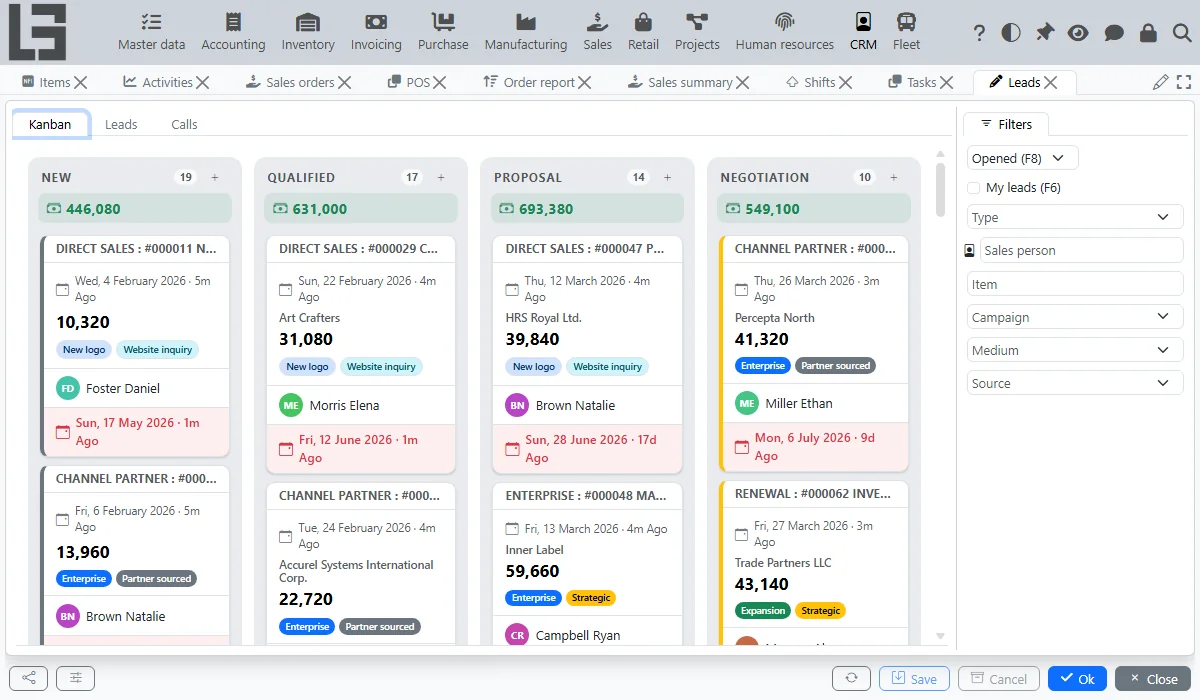
CRM kanban board in MyCompany, a free open-source ERP for small business
FREE
Truly free coreno crippled trials
OWN
Your server, your dataself-hosted by design
What we compared in every system
  • License
  • What is actually free
  • Paid boundaries
  • Hosting
  • Best fit

How this list was built

Three rules kept the list honest

Every system here is open source with an active project in 2026, can be self-hosted on your own server, and offers a genuinely usable free core — not a trial. Where a project draws a free/paid line, we say so explicitly and link the official source.

Jump to the detailed breakdown →
The 2026 shortlistlicenses verified July 2026
MC
MyCompanyAll modules in one free edition · our product
Apache 2.0
EN
ERPNextWidest fully-free feature set in this list
GPL v3
OC
Odoo CommunityLargest ecosystem of the five; freemium boundary
LGPL v3
DL
DolibarrEasy start on simple PHP hosting
GPL v3+
TR
TrytonFoundation-run, stability first
GPL v3+
FREE license · self-hosting · core modules
CHECK paid editions · hosting plans · addons

The shortlist in detail

Five free ERP systems, compared honestly

Numbered for navigation, not as a quality ranking — each entry spells out the project's own free/paid line. Why MyCompany opens the list is answered plainly in the FAQ below.

1 · MyCompanyour product
What is freeEverything. Inventory, invoicing, manufacturing, sales, purchasing, projects, HR, CRM and retail POS ship in one edition with a single database — no per-user fees, no feature gates.Apache 2.0
Paid optionsNone in the product itself. Optional custom development services are available if you want workflows built for you.services
StrengthsRuns on a 4 GB RAM server and installs in about 15 minutes; deep customization on the lsFusion platform (Java + PostgreSQL); Apache 2.0 even allows commercial white-label products.custom
Keep in mindA younger project with a smaller community than ERPNext or Odoo, and self-hosted only — there is no managed SaaS plan.honest
Best forSmall teams that want every module free at any team size and the freedom to reshape the system to their processes. Open the live demo — no login needed.SMB
2 · ERPNextGPL v3
What is freeThe full suite — accounting, inventory, manufacturing, CRM, projects, POS, HR — is open source with no features held back behind paywalls.all free
Paid optionsFrappe Cloud, the vendor's managed hosting and support platform, if you prefer not to run your own server.hosting
StrengthsThe broadest out-of-the-box coverage among the systems reviewed here, backed by a very large community and the Frappe framework ecosystem.breadth
Keep in mindSelf-hosting the Frappe stack takes some DevOps comfort, and deep customization means learning the framework.stack
Best forSMBs that want maximum functionality on day one with a big community behind it.SMB+
3 · Odoo CommunityLGPL v3
What is freeThe open-source Community edition, self-hosted, covering core business apps. Odoo also advertises a One App Free plan on its managed cloud.core
Paid optionsThe Enterprise edition (per-user subscription) with additional licensed features, plus paid multi-app Odoo Online plans and Odoo.sh hosting.freemium
StrengthsPolished UX, a very large app and partner ecosystem, and strong country localizations.ecosystem
Keep in mindMany well-known features live in paid Enterprise; compare the official editions page before assuming a feature is free. We keep a detailed MyCompany vs Odoo comparison.gates
Best forTeams that value ecosystem breadth and design polish and accept the freemium boundary.scale-up
4 · DolibarrGPL v3+
What is freeThe entire modular suite — CRM and sales, stock, invoicing, HR — where you enable only the modules you need.all free
Paid optionsThird-party addons on the DoliStore marketplace and cloud hosting from partner providers.addons
StrengthsA simple PHP/MySQL stack that runs on inexpensive shared hosting — one of the cheapest ways to start an ERP.light
Keep in mindThe interface is more utilitarian, and advanced scenarios often rely on third-party addons of varying quality.addons
Best forMicro and small businesses that want a light, low-cost start.micro
5 · TrytonGPL v3+
What is freeThe complete modular platform: financial accounting, sales, inventory, purchasing, manufacturing and project management.all free
Paid optionsNone from the project itself — implementation and support come from a network of independent service providers.partners
StrengthsRun by a non-profit foundation with disciplined long-term releases and a particularly solid accounting core, designed to avoid vendor lock-in.stable
Keep in mindA smaller ecosystem and a plainer interface; most companies engage a service provider or set aside technical time for setup.setup
Best forCompanies that prioritize vendor-neutral governance and multi-year stability.long-term

Read the fine print

What "free ERP" can quietly hide

Three boundaries to check in any system before you commit your data and processes.

GATE

Feature-gated editions

The free edition exists, but reports, mobile apps or key modules sit in a paid tier. Compare edition pages, not marketing pages.

SEAT

Per-user pricing later

Free for a few seats, then every new employee raises the bill. Prefer licenses where team growth costs nothing.

LOCK

Hosting lock-in

If the free plan only exists in the vendor's cloud, moving out later is a migration project. Self-hosting keeps the exit door open.

How to choose

A one-afternoon selection process

You do not need a consulting engagement to pick a free ERP. Shortlist by license honesty, confirm you can run the stack, then pilot your one most painful process end to end.

  1. 01
    Check what stays free as you groweditions, seats, modules
    license
  2. 02
    Confirm the stack you can hostPHP · Python · Java + a small VPS
    hosting
  3. 03
    Pilot one real process in a demoorder-to-invoice or purchase-to-stock
    fit
  4. 04
    Test the customization pathwill small changes survive upgrades?
    future

Primary sources

Verify the claims — editions and licenses change

This roundup reflects official project materials reviewed in July 2026. Before deciding, check the current pages: Odoo editions, ERPNext, Dolibarr, Tryton and the MyCompany source code. Licenses are stated in each project's repository — for example ERPNext and Dolibarr on GitHub.

LIC
Licensesproject repositories
ED
Editionsofficial comparison pages
VERIFYthen decide
DEMO
Demosyour process, not slides
DOCS
Install docscan your team run it?

Common questions

Free ERP, without the fine print

Something unanswered? Ask us directly.

Is free ERP software really free?

The license can be genuinely free — every system here is open source. You still invest in hosting (a small server or VPS) and implementation time. The differences are in what each edition includes: some projects keep every module free, others reserve advanced features for paid editions.

Do I need my own server?

For the self-hosted route, yes — but a modest one. MyCompany starts on about 4 GB of RAM. Most projects here also have managed cloud options from the vendor or third-party providers if you prefer not to run a server.

Which free ERP is the easiest to start with?

Dolibarr is famously easy to launch on inexpensive PHP hosting. MyCompany installs on a clean Linux server or Docker in roughly 15 minutes. ERPNext and Odoo are straightforward via their images, though their stacks are heavier to maintain long-term.

What is the catch with Odoo's free options?

Odoo Community is genuinely open source, and Odoo advertises a One App Free online plan. But many well-known features belong to the paid Enterprise edition, and multi-app online usage is subscription-based. Review Odoo's official editions and pricing pages for the current boundaries.

Why is MyCompany listed first?

Because it is our product, and this page says so openly instead of pretending to be neutral. Every entry lists honest strengths and trade-offs, each system has a free demo or download — so the fairest test is running your own workflow in each candidate.

Start with the live demo

Test a real workflow, not a feature list

Open the MyCompany demo — no registration — and run one process end to end. Then do the same in the alternatives and compare.

Contact Us